
A pancake brand started in 1982, selling door-to-door in brown paper bags. For thirty years it barely moved. Then, in the space of a decade, it hit $200 million a year in revenue — without reinventing the product, without a viral moment, and after being rejected by every investor on Shark Tank.
Kodiak Cakes didn’t change what they sold. They changed the story they told — and more importantly, who they told it to. That single strategic shift is the most repeatable growth pattern we see in ecommerce right now. And for the brands you work with as a hosting partner or agency, it’s the conversation that separates a client who stays stuck from one who breaks out.
This post walks through the PROP framework — the four-step system behind Kodiak’s growth — and shows you exactly how it maps to what BrandForge helps your clients build from day one.
Why Most Brands Stay Invisible
Most brands make the same mistake: they try to appeal to everyone. They add more product lines. They run ads at every demographic. They write copy that could describe any product in any category. The result is static — a blur of noise where no one can hear the actual signal.
Kodiak Cakes was that brand for three decades. Healthy pancakes for families, for dieters, for weekend brunchers. A fine product with no particular reason to choose it over anything else on the shelf. The turning point came when they stopped broadcasting to everyone and started transmitting on one very specific frequency: the fitness community. People who counted macros. Who wanted comfort food that didn’t break their diet. Who had no good option and knew it.
When you serve one obsessed audience instead of a vague general one, everything changes — the product story, the content, the community, the loyalty. And critically: a smaller, more specific audience is not a disadvantage. It’s the whole point. Big brands physically cannot market to one tight subset of a community the way a focused smaller brand can. That asymmetry is your client’s edge.
The PROP Framework: Four Steps to a Breakout Brand
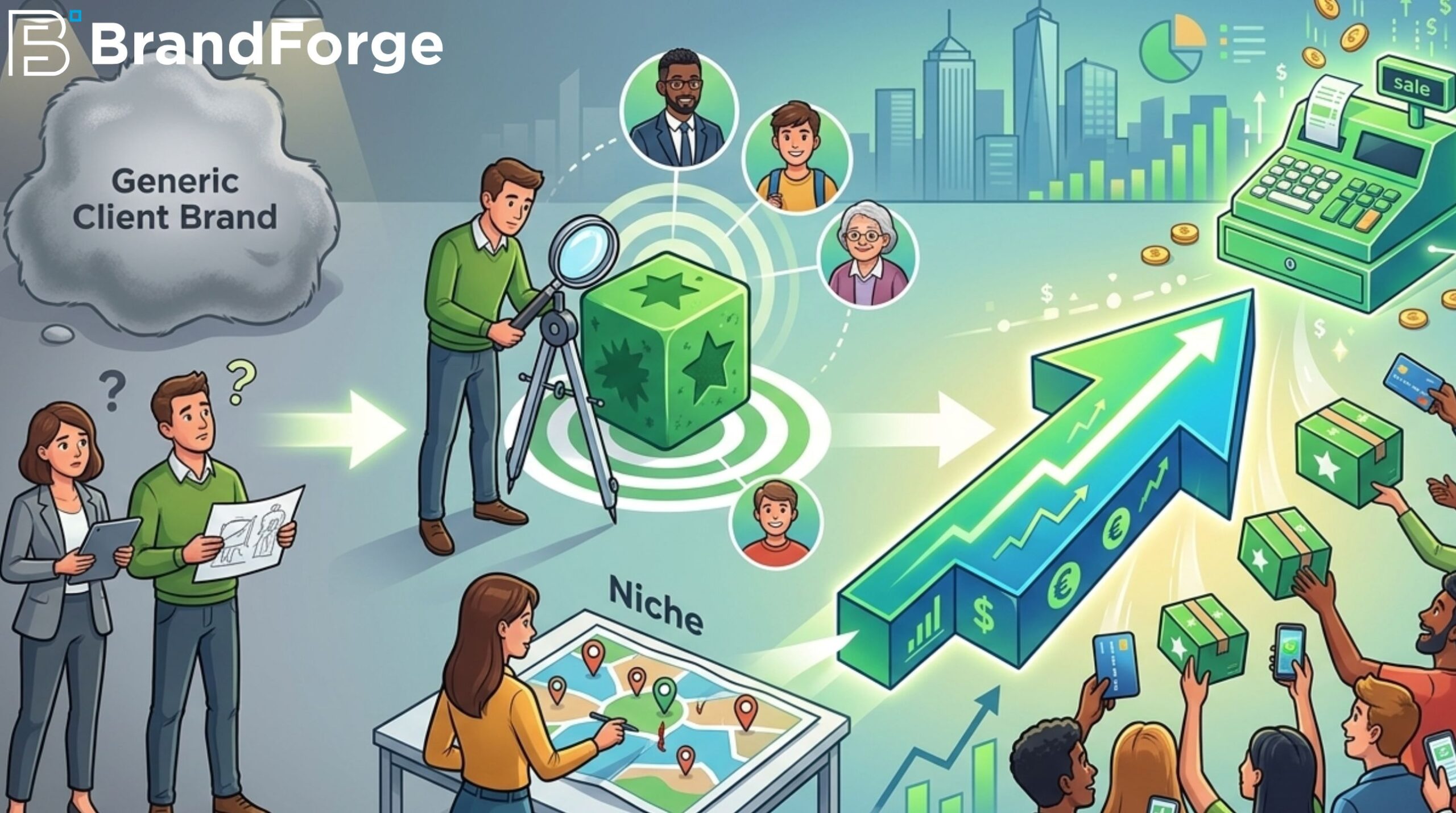
The pattern Kodiak Cakes followed — and that we see repeated in fast-growing ecommerce brands right now — breaks down into four steps. We call it PROP.
Use trend data to find what your audience is struggling with before it hits mainstream. Look for clusters of products solving the same problem.
Don’t change the product — change what it means. Find the emotional contradiction your audience lives with and position your brand as the solution.
Stop selling to everyone. Pick one person with a painful, specific problem and build everything — content, community, tone — around them.
Make customers feel like insiders. Handwritten notes, personal replies, early access, closed feedback loops. This turns buyers into a marketing team.
Let’s walk through each one and show what it means in practice for the brands you work with.
Step 1 — Pinpoint the Rising Pain Point
Kodiak Cakes didn’t invent protein obsession. They spotted it early, when fitness culture was growing fast but nobody had brought it to comfort food yet. That gap — a rising, underserved pain point — is where breakout brands live.
The same pattern plays out repeatedly. Olipop didn’t invent soda. They spotted rising interest in gut health and prebiotics, then built a soda that solved for that. The product category was old. The pain point was new. The repositioning was the entire move.
For your clients, the job is to use data tools — Google Trends, Exploding Topics — to find what’s rising in their category before it becomes obvious. Look for clusters: groups of products or searches that share the same underlying concern. That shared concern is the pain point. The brand that names it first and owns it wins.
Step 2 — Reposition the Story, Not the Product
This is the step most brands skip entirely, and it’s the one that matters most. Repositioning isn’t a rebrand. It isn’t a new logo or a new product line. It’s identifying the emotional tension your audience lives with — comfort vs. discipline, luxury vs. affordability, fun vs. productivity — and making your brand the resolution of that tension.
Kodiak didn’t change the pancake recipe. They changed the sentence. “Healthy pancakes” became “protein-packed pre-workout fuel.” Same oats, entirely different meaning. One is a compromise. The other is an identity.
For your clients, this translates to one practical action: rewrite the product description and the homepage headline through the lens of the pain point, not the product feature. Then test it — a micro-influencer post or a small ad set is enough to see whether the new story resonates. If engagement lifts, double down.
Step 3 — Own One Tribe Completely
Most brands have customers. The ones that break out have communities. There’s a meaningful difference. A customer buys once because the price was right. A community member buys repeatedly, tells friends, defends the brand online, and sends unsolicited content that does the marketing for you.
Kodiak became the go-to brand for the fitness community not just because the product fit, but because every piece of content, every campaign, every packaging decision spoke directly to that one tribe. When you serve one obsessed audience, your customers stop being buyers and start being advocates. That’s how a brand that got rejected on Shark Tank still saw sales explode the week the episode aired — the community saw themselves in the product and did the rest.
For your clients, this means picking one person with a specific, painful problem and building everything around them. One community channel — a Facebook group, Discord, or email list — where they feel like insiders. Content that speaks to their identity, not their shopping habits. And crucially: closing the feedback loop. When a customer suggests something and the brand implements it, that customer becomes a loyal evangelist. Not because they were incentivised, but because they feel ownership.
Step 4 — Personalise Every Touchpoint
The fourth step is the one that turns a good brand into an unforgettable one. At a time when ecommerce is becoming increasingly automated — AI-generated responses, templated fulfilment emails, cookie-cutter unboxing — the brands that do the small human things stand out completely.
A handwritten thank-you note in a box. A personal DM to someone who left a review. Implementing a customer’s suggestion and telling them you did it. Giving your most active community members early access to new products. These gestures cost almost nothing and create disproportionate loyalty. Everlane built a fanbase largely on a handwritten thank-you in every box. Kodiak kept their gritty outdoor voice even as they scaled to $200M, because it made every customer feel like the brand was still talking directly to them.
For your clients this is the most actionable step. Suggest they write a personal DM to their next twenty customers who leave a review. Track those customers for sixty days. Watch what happens to repeat purchase rate. Then build that loop into the product — automated but personal, systematic but genuine.
What This Means for You as a Partner
The PROP framework isn’t just a brand strategy story. It’s a template for the conversation you can have with every client who comes to you with a product they can’t seem to sell.
Most of the time, the product isn’t the problem. The story is. And the solution isn’t more ad spend or a new colour palette — it’s clarity: a precise pain point, a repositioned narrative, an audience of one that grows into a tribe. That’s the work that happens before a single euro goes into advertising. And it’s the work that BrandForge is built to accelerate.
- Pinpoint — Use trend data to find the rising pain point in your client’s category. Don’t guess. Look for clusters.
- Reposition — Rewrite the product story around the emotional tension the audience lives with. Test it small before scaling.
- Own the tribe — Pick one customer, one problem, one community. Build everything for them. Let them become the marketing team.
- Personalise — Add the human layer that automation can’t fake. Close feedback loops. Make customers feel like insiders.
The leap from obscurity to $200M isn’t always about budget or luck. Sometimes it’s just changing the story. And the partners who help their clients find that story early — before the ad spend, before the pivot — are the ones who build long-term client relationships that last.

BrandForge walks every new brand through audience definition, brand naming, and story positioning before a single page goes live. Built for hosting partners and agencies who want to give their clients a real competitive edge from day one.
Become a BrandForge Partner →